
Red light therapy is one of the most straightforward wellness tools you can use at home — but eye safety is a question that comes up constantly, and it deserves a clear, honest answer. This guide walks through exactly when eye protection matters, what kind works best, and how to set up your sessions for lasting comfort.
Is Red Light Therapy Safe for Your Eyes?
The short answer: red light therapy is fundamentally different from light sources that are known to be hard on eyes. The wavelengths used — typically 630–850 nm — sit in the red and near-infrared portion of the spectrum, well away from UV radiation. UV light (below ~400 nm) is the primary driver of sun-related eye damage; red and near-infrared light carry significantly less energy per photon and do not share those risks.
In fact, research has explored red and near-infrared light specifically in the context of ocular applications. Studies from University College London, for example, have looked at how deep red wavelengths around 670 nm interact with retinal mitochondria. Red light is not an inherently threatening wavelength for eyes the way UV is.
That said, high-powered LED panels are very bright — and staring directly into any bright light source for extended periods is uncomfortable and inadvisable. The practical concern with home-use red light therapy panels isn't a UV-style chemical hazard; it's the sheer intensity of modern panels and the importance of not letting that brightness fall directly on your eyes during face and scalp sessions.
Bottom line: Red light is not dangerous in the way UV light is, but protecting your eyes during face sessions is a smart, low-effort habit — and the right choice for any serious user.
When Do You Need Eye Protection?
Not every session carries the same eye exposure risk. Where you're pointing the panel — and whether your eyes are within the beam — determines what level of precaution makes sense.
Face and Scalp Sessions
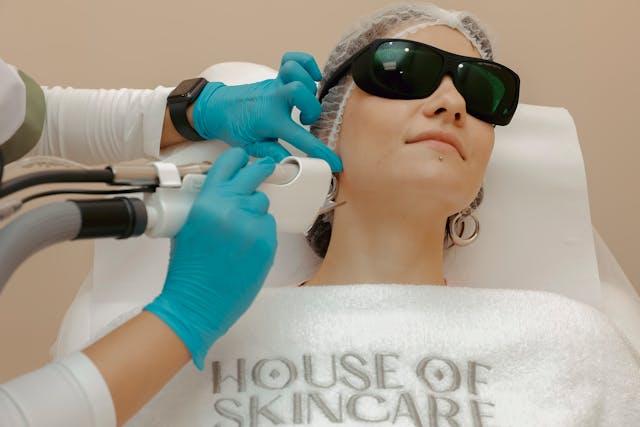
If your face or scalp is the focus area, your eyes are in direct line with the panel. This is the scenario where eye protection is most important. Use dedicated red light therapy goggles or keep your eyes fully closed for the duration of the session. The brightness alone can cause strain, and regular, repeated exposure without protection isn't a habit worth building.
Body Sessions (Chest, Back, Legs)
When you're targeting your chest, back, arms, or legs, your face is typically turned away from the panel or well outside the beam window. In these cases, eye protection isn't generally needed — provided you're not looking directly at the device. Set up the panel, position yourself, and let it run. There's no need to fumble with goggles every time you do a back session.
Near-Infrared Only Mode
Many Hooga panels include a near-infrared only mode, which emits light in the 810–850 nm range. NIR is invisible to the naked eye, so you won't see a glow — but the light is still there, and the panel can still be uncomfortably bright if you look at it directly. For face and scalp sessions using NIR mode, treat it the same as a visible red session: use goggles or close your eyes. Because you can't see NIR, there's no natural visual signal to look away, which makes caution especially worthwhile here.
What Kind of Eye Protection Should You Use?
The type of protection you choose affects how well your eyes are actually shielded. Not all options are created equal.
Red Light Therapy Goggles
Purpose-built red light therapy goggles are the best option for regular users. They're designed to block the specific wavelengths used in therapy — both visible red (630–660 nm) and near-infrared (810–850 nm) — and are typically rated by optical density (OD), a measure of how thoroughly they block those wavelengths. Goggles with OD 5+ across the relevant range offer reliable protection and are the standard recommendation for photobiomodulation use.
Look for goggles that fit snugly with no light leakage around the edges, and that are comfortable enough to wear for a full session without becoming a distraction. Hooga's protective glasses are designed specifically for use with Hooga panels, blocking the red and NIR wavelengths while remaining lightweight and comfortable.
Standard Sunglasses
Regular sunglasses — including polarized or UV400 lenses — are not an adequate substitute. Sunglasses are engineered to block UV light and reduce overall visible glare, but UV protection means filtering wavelengths below ~400 nm. Red and near-infrared light sits at 630–850 nm: the opposite end of the spectrum. Most sunglasses allow a substantial portion of these wavelengths to pass right through, creating a false sense of security without meaningful protection.
Simply Closing Your Eyes
Closing your eyes reduces light exposure considerably and is a reasonable choice for casual or short face sessions. However, eyelids are thin enough that near-infrared wavelengths can penetrate them to some degree. For occasional, brief sessions it's a workable approach — but for regular face and scalp use, dedicated goggles are more reliable and take the guesswork out of it entirely.
How to Position Your Device for Eye Comfort
Distance and angle play a significant role in how much light reaches your eyes, even during non-face sessions.
The standard recommended distance for most Hooga panels is 6–12 inches for targeted sessions, with irradiance decreasing as you move further back. For face sessions, the upper end of that range — or even slightly further — can make the experience more comfortable without meaningfully reducing the output your skin receives. Check the full guide on device distance for specific recommendations based on session type and panel model.
Angling the panel slightly — rather than pointing it directly at your face — is another practical option for face sessions. Tilting it downward to target your cheeks and neck reduces the direct line of exposure to your eyes while still covering the intended area.
Hooga panels are designed to be wall-mounted or used on stands, which makes it easy to position them at a consistent height and angle for every session. Consistency in your setup reduces variables and makes it easier to build a reliable routine.
Tips for Comfortable Red Light Therapy Sessions
A few habits make a significant difference in the quality and comfort of your sessions over time.
Start with shorter sessions. If you're new to red light therapy, begin with 5–10 minute sessions before working up to longer exposures. Your eyes — and your skin — benefit from gradual adaptation. Jumping straight to 20-minute full-body sessions can lead to unnecessary discomfort.
Use a timer. Hooga panels, including the HGPro300, include built-in timers so you don't have to watch a clock or guess when your session ends. Set it and relax. Consistent session lengths also make it easier to track what's working for you.
Don't stare directly into the LEDs. Even during body sessions where your face isn't in the beam, avoid looking directly at the panel. This applies whether the mode is red, NIR, or both. There's no reason to look at the device — position yourself, start the timer, and let the session run.
Understand the difference between modes. If your panel has separate red and NIR modes, know which one you're using at any given time. NIR-only sessions warrant the same eye precautions as combined sessions, especially for the face.
For a full breakdown of recommended session lengths, frequencies, and output levels, see the red light therapy dosage and timing guide.
Frequently Asked Questions
Can red light therapy damage your eyes?
Red light at 630–850 nm does not carry the UV-type risk associated with sunlight. Research has not established LED-based red light therapy as damaging to eyes when used as directed. That said, staring directly into a high-powered panel for extended periods is uncomfortable and, with near-infrared wavelengths, could contribute to thermal stress over time. Using eye protection during face sessions is straightforward insurance — the goggles are inexpensive and the habit is easy to build.
Can I do red light therapy without goggles?
For body sessions where your face is turned away from the panel, goggles are generally not needed. For face and scalp sessions, the better practice is to use goggles or keep your eyes fully closed. If you're doing occasional, short face sessions with your eyes closed, the risk is low — but goggles are more reliable for regular use.
Is near-infrared light bad for your eyes?
Near-infrared light (810–850 nm) is invisible, which means the eye doesn't constrict naturally in response to it. This is the main reason extra caution makes sense for NIR during face sessions — there's no visual prompt to look away. NIR can penetrate deeper into tissue than visible red light, and for sessions where your eyes are in the beam window, goggles are the smart choice. For body sessions with your face averted, NIR exposure to the eyes is minimal.
Can I wear contact lenses during red light therapy?
Contact lenses don't offer any protection against red or near-infrared light, but they're also not a reason to skip a session. For face sessions, wear your goggles as you normally would — contacts or not. If you're doing a body session and not looking at the panel, contact lenses are a non-issue. If your eyes feel dry or irritated after sessions, it's worth mentioning to your eye care provider, as some people are more sensitive to bright light with contacts in.
The Bottom Line
Red light therapy is a well-studied, non-UV technology that operates in a fundamentally different part of the spectrum from the light sources that genuinely stress eye tissue. Used correctly, it's a comfortable, low-risk addition to a wellness routine.
The practical guidance is simple: use goggles or close your eyes for face and scalp sessions, skip them for body sessions where you're not looking at the panel, and don't make a habit of staring directly into the LEDs regardless of what you're targeting.
If you want to go further — learning about potential side effects, understanding how to read your device's output specifications, or exploring the broader science — the complete red light therapy guide is a good next step. And if you're experiencing any discomfort after sessions, the side effects overview covers what's normal and what's worth paying attention to.
Ready to build your setup? Browse Hooga's full range of red light therapy devices to find the panel that fits your routine.